Industrial Robotics with Florenetes
The Florenetes platform can be applied in any industry that uses intelligent mobile agents of any kind, which require coordination to operate efficiently.
Florenetes transforms industrial robotics by ensuring uninterrupted coordination of mobile agents, even during a complete failure of cloud infrastructure and communication networks. This enables businesses to reduce capital and operational costs on infrastructure by 30-50% while simultaneously increasing system resilience. In this article, we'll explore how this works using examples of an automated port and a smart agriculture enterprise.
Uninterrupted Logistics
A Smart Port That Never Stops
Imagine a smart port of the future, equipped with automated cranes and autonomous container carriers powered by AI for navigation on autopilot. This port has several berths for container ships and multiple warehouses where containers must be delivered from the ships.
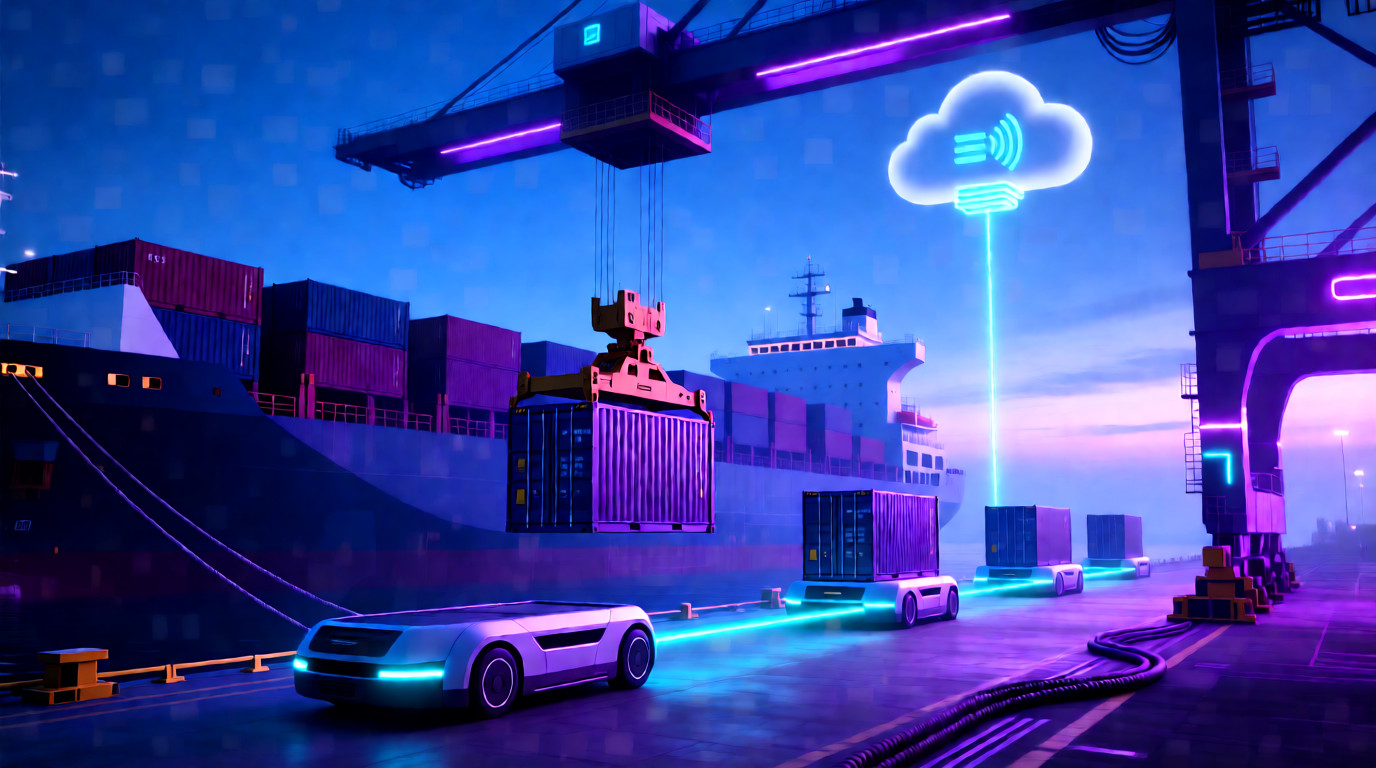
The workflow of an autonomous carrier consists of the following steps:
- Select an available berth and navigate to it for loading
- Receive a container from an automated crane
- Deliver the container to its designated warehouse
This workflow involves two critical coordination operations:
- Berth selection: Without coordination, carriers might form queues while other berths remain idle.
- Warehouse assignment: Each carrier needs this information to deliver its cargo.
Problems with Cloud-Based IoT Approach
Consider a port using a traditional IoT management system: all carriers are equipped with cellular modems and connected to a cloud server that handles all coordination logic:
- When a carrier needs a berth, it queries the cloud. The cloud knows the status of all carriers and berths, and assigns an available (or highest priority) berth.
- When a carrier needs a warehouse assignment, it queries the cloud. The cloud knows all warehouse statuses, container origins and destinations, and assigns an appropriate warehouse.
If an incident occurs — cellular network disruption or cloud server failure — port operations come to a halt until infrastructure is restored, despite carriers being "autonomous". Their autonomy is thus severely limited.
To mitigate downtime costs, port owners invest in infrastructure redundancy:
- Backup cloud servers across multiple data centers
- Backup power supplies for cellular towers
- Redundant internet connections from different providers
These are costly investments that don't always perform as planned because failures are exceptional events that occur infrequently, making failover scenarios far less tested than normal operations.
The Florenetes Solution
When a port implements a Florenetes-based management system, carriers are additionally equipped with Wi-Fi modules for peer-to-peer operation, enabling them to exchange data without relying on communication infrastructure — no Wi-Fi access points needed.
During normal operation, the port functions similarly to a cloud IoT system. The cloud-based management system coordinates all carriers. Florenetes' advantages emerge during infrastructure failures.
If an incident occurs — cellular network disruption or cloud infrastructure failure — port operations do not stop. The port management application, running in the Florenetes cluster, automatically replicates itself across all agents, including caching the relevant portion of the container database. When cellular connectivity is lost, carriers automatically switch to a mesh network built using Florete technology over peer-to-peer Wi-Fi links. The distributed management service that assigns available berths and warehouses continues operating over this mesh network!
When cloud access is restored, the cloud component of the port management system automatically synchronizes with the port's current state.
Florenetes Value for Logistics Businesses
Port owners can reduce infrastructure costs by:
- Reducing the number of cellular towers on-site: coverage in remote areas is achieved through the mesh network
- Reducing investments in backup power infrastructure
- Reducing investments in cloud data center redundancy
- Reducing investments in redundant internet providers
Simultaneously, downtime risks during incidents decrease: for Florenetes, operating in distributed mode using a mesh network isn't an exceptional scenario — it's the normal, thoroughly tested, and reliable mode of operation.
Port owners can reduce CAPEX/OPEX on communication infrastructure and its redundancy by 30-50%, while improving system availability (SLA) from 99.9% to 99.99% by transitioning from rare failure scenarios to standard distributed operation.
Autonomous Field Operations
Smart Agriculture Without Astronomical Satellite Bills
Imagine a smart agricultural enterprise of the future, equipped with autonomous tractors. The enterprise manages multiple farmlands, some of which are remote areas without cellular coverage.
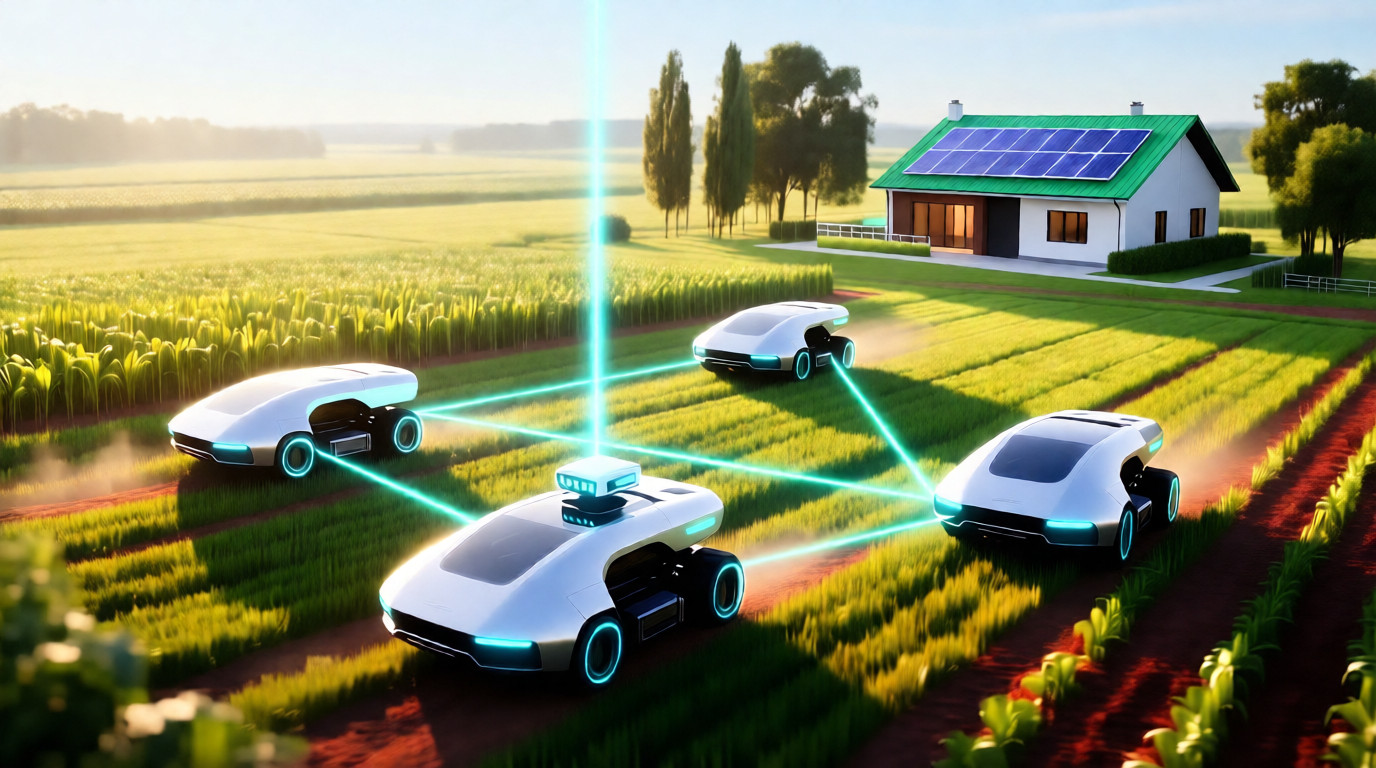
The workflow of an autonomous tractor during group operations includes:
- Arrive at the field for processing
- Process its assigned portion of the field
- Move to the next field or return to base
This workflow involves one crucial, continuous coordination operation: each tractor must select an unprocessed field section not yet occupied by other tractors in the group.
Problems with Cloud-Based IoT Approach
If tractors use a traditional IoT management system, each must be equipped with a low Earth orbit (LEO) satellite terminal: field operations cannot rely on cellular networks, as covering all fields with cellular connectivity is impractical.
Foreign LEO satellite terminals and satellite traffic are currently unavailable in Russia. When domestic alternatives emerge, they will likely be very expensive initially.
Via satellite connectivity, all tractors connect to a cloud management system. It "sees" each tractor's real-time position and distributes field sections among them for maximum efficiency (avoiding overlaps and gaps).
If an incident occurs — satellite communication disruption or cloud server failure — field operations come to a halt until infrastructure is restored: without it, tractors cannot coordinate or select available field sections. Their autonomy and intelligence are thus severely limited.
Such tractors, deprived of management, become "stranded in the field". If the outage is prolonged, technicians must visit each tractor individually to issue local commands.
The Florenetes Solution
When a farm uses a Florenetes-based management system, tractors are equipped with directional antenna Wi-Fi modules for peer-to-peer operation, enabling them to exchange data without communication infrastructure.
This creates an opportunity to reduce costs on satellite terminals and traffic: equipping just 1-2 tractors per field group is sufficient. All other tractors can connect to the cloud through these designated machines, with automatic optimal route selection and redundancy provided by Florete Network. Thus, Florenetes reduces operational expenses even during normal operation.
It provides even greater benefits during incidents — satellite communication disruption or cloud server failure — field processing does not stop. The tractor management system, allocating field sections for processing, continues operating as a distributed service over the mesh network.
To restore human control, technicians don't need to connect to each tractor locally — connecting to just one provides access to manage all tractors simultaneously. This can be done without even visiting the field — for example, using a drone integrated into the Florenetes cluster.
Florenetes Value for Agribusiness
Farm owners can reduce costs by:
- Decreasing the number of satellite terminals and related traffic by an order of magnitude while maintaining the same connection reliability
- Reducing investments in cloud data center redundancy
Simultaneously, downtime risks during infrastructure failures decrease: agricultural machinery continues operating and remains manageable even during satellite network outages.
Agricultural holdings can reduce the number of expensive satellite terminals by 5-10 times, save millions of dollars annually on subscription fees, and eliminate risks of multi-day equipment downtime in fields.
Other Industries
Similarly, Florenetes can benefit numerous other industries. In automated mining, road construction, and pipeline projects, it helps save on cellular infrastructure by replacing the "last mile" with its Florete-based mesh network. For facility monitoring, it ensures security even during internet outages.
We're preparing more Florenetes use cases. Follow new case studies on our blog and on Telegram channel @rete_labs.
Florenetes principles are universal for any field with mobile autonomous agents, from quarry haul trucks to warehouse robots and inspection drones. Discuss your challenge with our engineers to evaluate potential cost savings and resilience improvements. Contact Us
Next Steps
- Want to discuss your project's networking and agent orchestration needs? Get technical consultation →
- Ready to see Florenetes in action for your use case? Discuss a pilot project →